 Nusan
Nusan
Why Vietnamese is trickier than it looks
Vietnamese uses the same alphabet as English, which makes it feel more accessible than Thai or Chinese at first glance. The catch is tone: Vietnamese has six tones, each marked by a small accent above or below a vowel, and each one can turn a word into something completely different. Ma can mean ghost, mother, tomb, rice seedling, horse, or a grammatical question particle — depending entirely on tone. Reading the word correctly is only half the job; saying it with the right pitch is the other half.
Phrases worth having ready
- Xin chào — hello, safe and appropriate in almost any setting.
- Cảm ơn — thank you, one of the most-used words you'll need.
- Bao nhiêu tiền? — how much is this? essential for markets and street stalls.
- Cho tôi ... — "give me ..." / "I'd like ...", the simplest way to order anything.
- Không cay — not spicy, worth knowing before ordering phở or bún.
- Nhà vệ sinh ở đâu? — where is the bathroom?
None of these are hard to memorize as text. What's hard is producing the tones correctly from a page — which is exactly where hearing them said aloud, rather than just reading them, makes the difference.
The romanization trap, in reverse
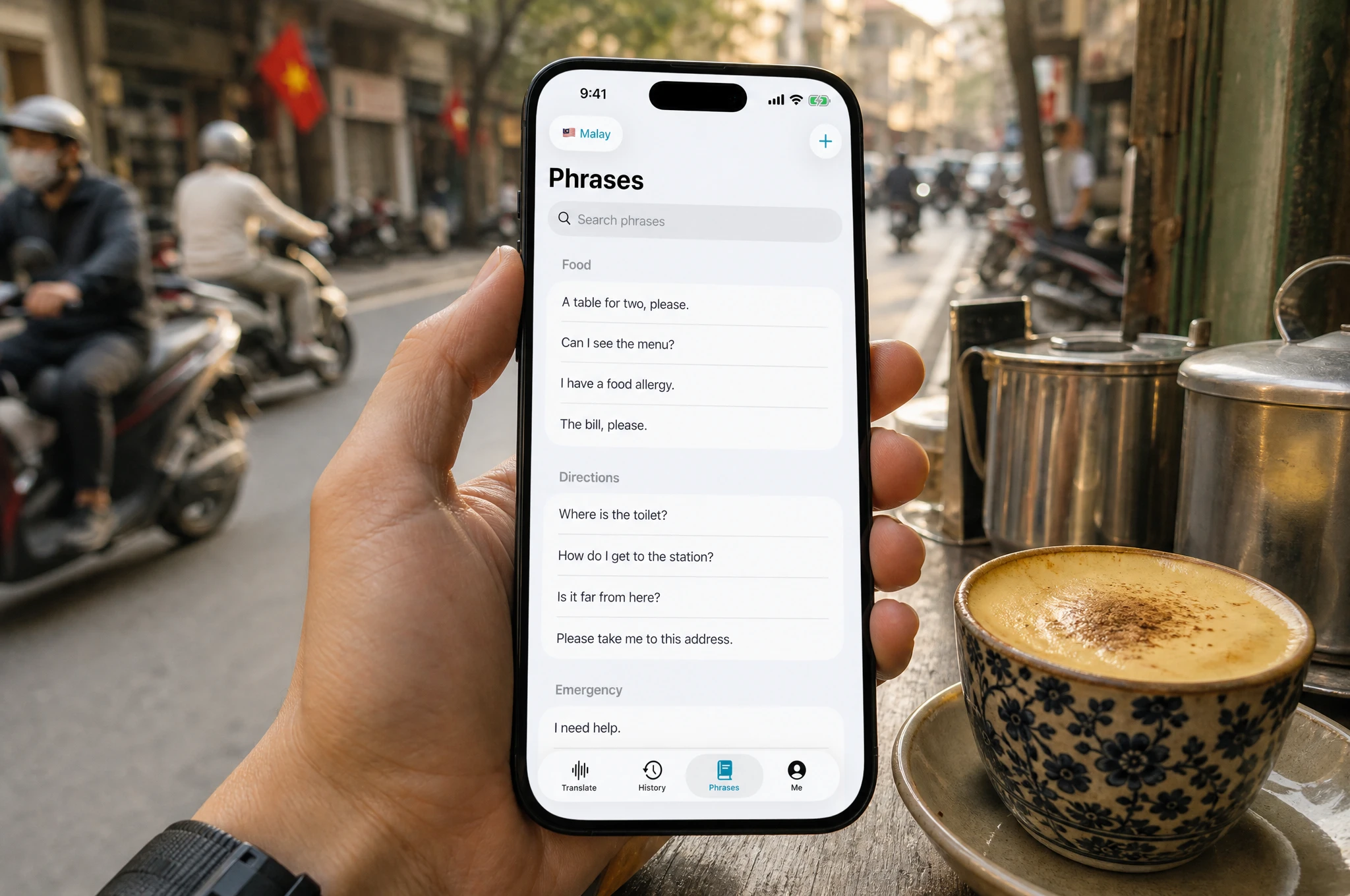
With Thai or Chinese, the challenge is translating into a script you can't read. With Vietnamese, the trap runs the other way: you can read every word on the page, which creates false confidence. Seeing cảm ơn written down doesn't tell you it's said with a falling-then-rising tone on the first syllable — you have to hear it. A translator that speaks the phrase aloud, not just displays it, closes that gap directly.
Regional accents to expect
Vietnamese pronunciation shifts noticeably between the north (Hanoi), central (Huế), and south (Ho Chi Minh City) — certain consonants and tone contours differ enough that a phrase learned in one region can sound slightly foreign in another. This isn't something to stress over as a visitor; locals are used to accented Vietnamese from travelers and from each other. What matters more is getting the general tone pattern close enough to be understood, not achieving one region's exact accent.
A practical approach for a short trip
- Learn the six phrases above by sound, not just by reading them.
- Use voice translation for anything beyond that rather than trying to construct sentences yourself — Vietnamese grammar has its own quirks that don't map directly from English.
- Let the app read translations aloud when you're unsure of a tone, and repeat what you hear rather than what you'd guess from the spelling.
- Don't worry about which regional accent you sound like — clear tones matter more than a specific accent.