 Nusan
Nusan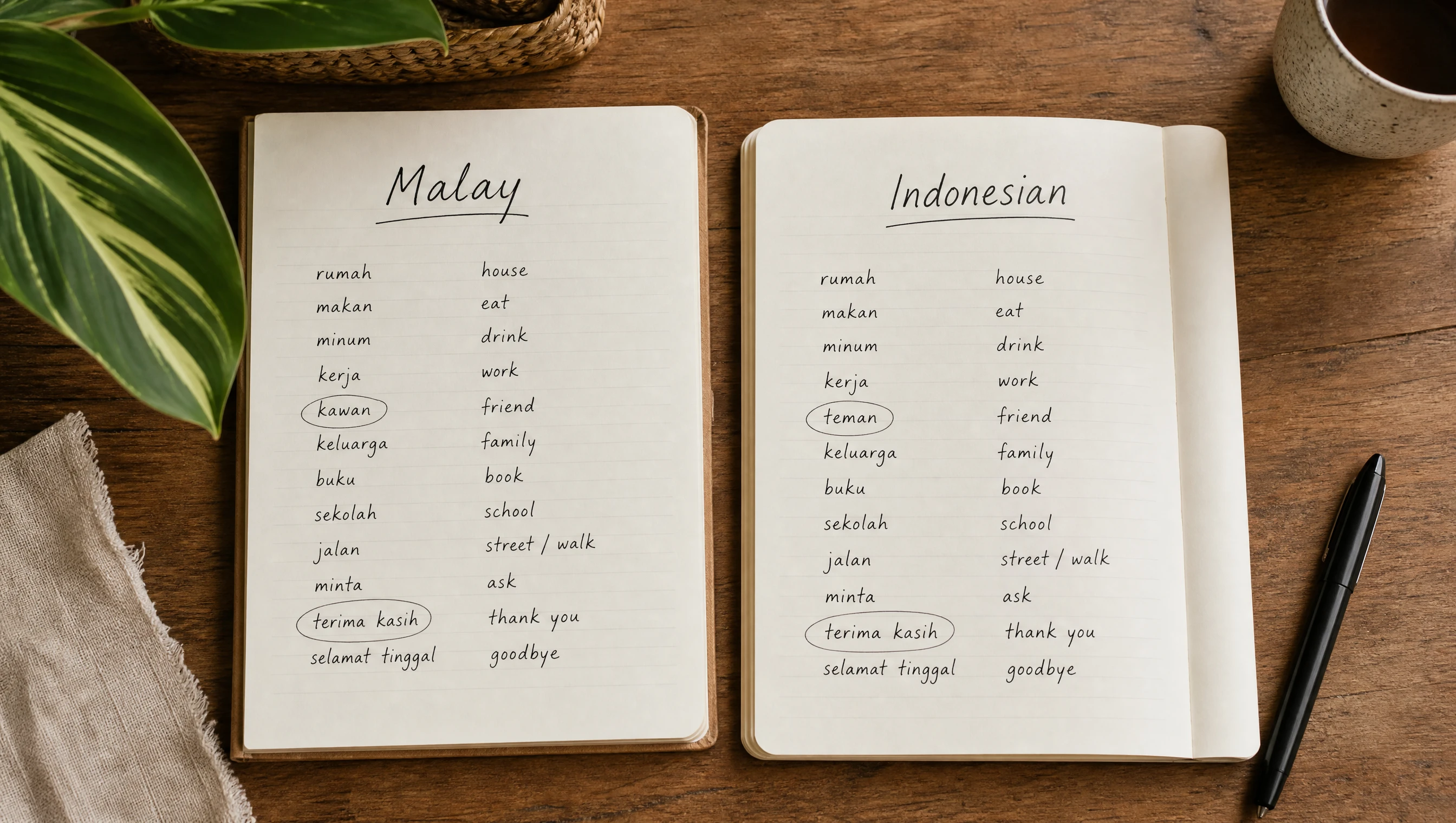
Where they come from
Malay and Indonesian both descend from the same root: Classical Malay, the trade language of the Malay Archipelago for centuries. Indonesian (Bahasa Indonesia) was standardized from Malay in the 20th century as the national language of a country with hundreds of local languages, while Malay (Bahasa Melayu) continued as the standard in Malaysia, Brunei, and Singapore. Think of them less as two unrelated languages and more like two branches that grew from the same trunk and then spent a century apart.
What's genuinely the same
A large share of everyday vocabulary is identical or near-identical: rumah (house), makan (eat), minum (drink), terima kasih (thank you), selamat tinggal (goodbye). Basic grammar — word order, how questions are formed, how plurals work — is close enough that a fluent speaker of one can read most of the other without much trouble.
Where they genuinely diverge
The differences show up in three places:
- Everyday vocabulary. "Friend" is kawan in Malay and more commonly teman in Indonesian (both words exist in both languages, but usage differs). "Office" is pejabat in Malay but kantor in Indonesian (borrowed from Dutch). Indonesian has absorbed more Dutch and Javanese influence; Malay has more English and Arabic loanwords.
- False friends. The most famous is budak — in Malay it casually means "kid," in Indonesian it means "slave." Say the wrong word to the wrong audience and you've said something very different from what you meant.
- Spelling and pronunciation. Both use the same 1972 spelling reform in principle, but everyday spelling and stress patterns still drift — Malay tends to preserve more original consonant sounds, Indonesian pronunciation is shaped by its Javanese-influenced speaker base.
Why this matters when you're traveling
If you're moving between Kuala Lumpur and Jakarta, or doing business across both markets, treating the two as fully interchangeable causes two kinds of problems: you sound noticeably foreign in ways that go beyond accent (using Indonesian vocabulary in Malaysia reads as odd, not just "close enough"), and occasionally you say something you didn't mean to, thanks to a false friend.
This is also why generic translation sometimes gets Southeast Asian languages wrong — a model trained mostly on one variant will default to it even when you selected the other, quietly swapping in the wrong word for "office" or "friend" without you noticing.
Getting it right in practice
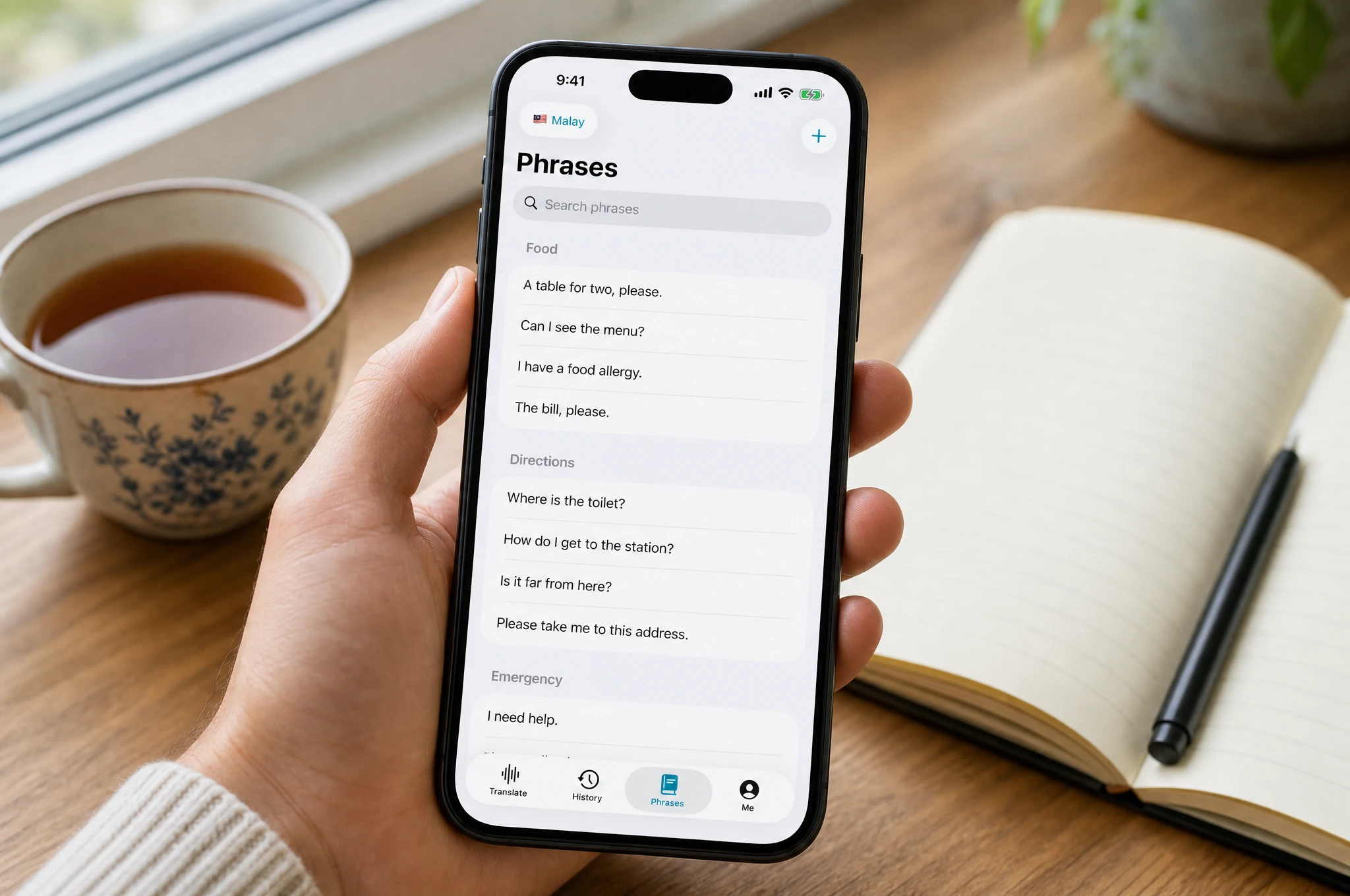
The fix isn't complicated: make sure whatever you're using treats Malay and Indonesian as distinct targets, not one generic "Malay/Indonesian" bucket. When they're set correctly:
- Vocabulary choices match the country you're actually in.
- Common phrases sound natural to a local, not just technically correct.
- You avoid the handful of well-known false friends that can genuinely confuse or embarrass.
Once that's set up, you can stop thinking about it — which is really the point. The two languages are close enough that most travelers don't need to study the differences; you just need translation that already knows them.