 Nusan
Nusan
Why "just use Google Translate" isn't a complete answer
General-purpose translators cover huge numbers of languages, and that breadth comes at a cost: they're rarely tuned for the specific quirks of any one region. Southeast Asia is linguistically dense — Thai and Vietnamese have tones that change a word's meaning entirely, Malay and Indonesian are close-but-different languages often lumped together, and several major languages (Thai, Chinese scripts) aren't in the Latin alphabet at all. A generic tool can translate the text; it often can't help you say it, or tell you when a word choice is off for the country you're actually in.
What actually matters for this region
- Coverage of the languages you'll actually use. Malay, Indonesian, Thai, Tagalog, Vietnamese, and the Chinese varieties spoken across the region (Mandarin, Cantonese) — not just "Chinese" as one bucket.
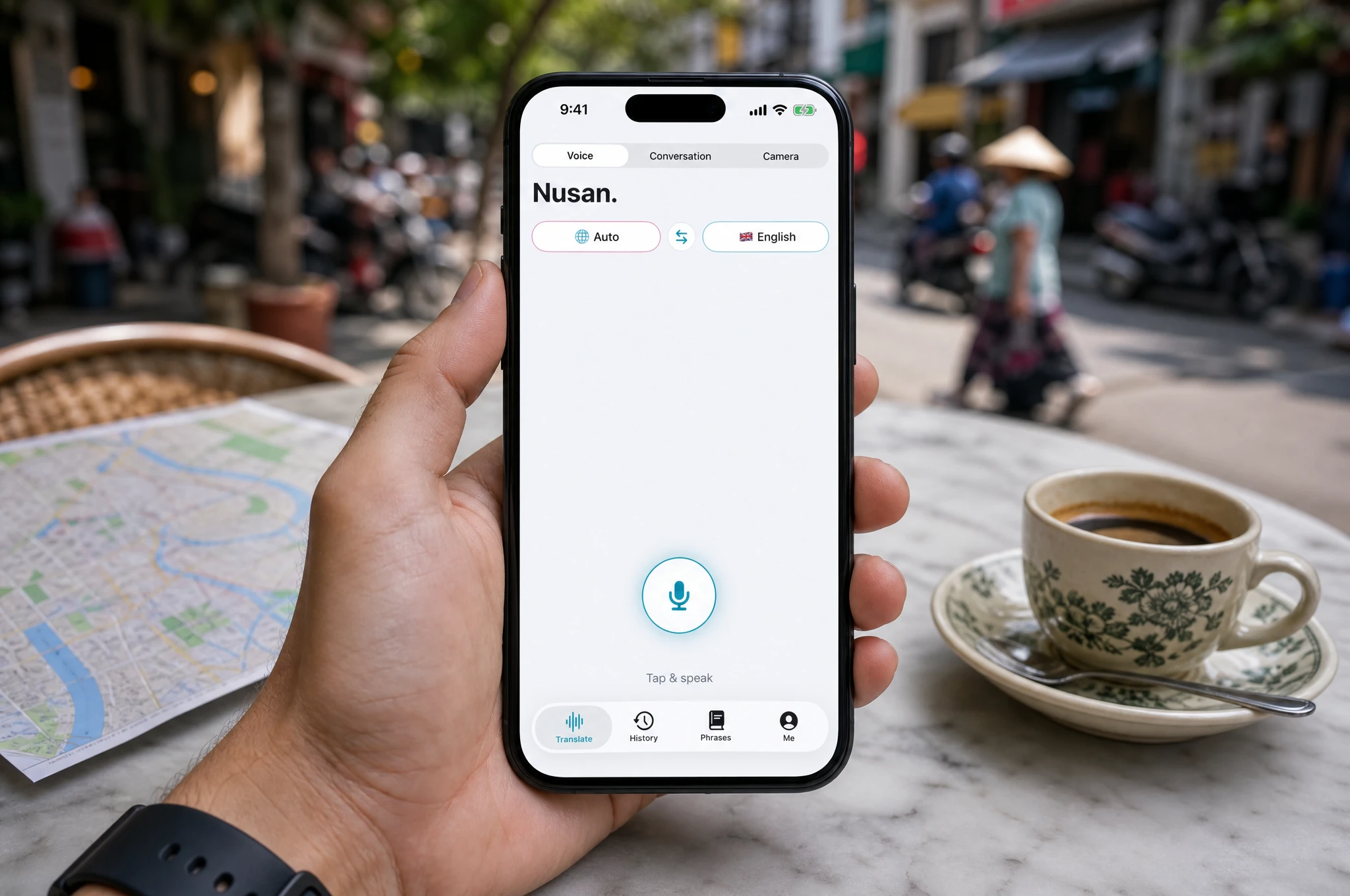
- Voice, not just text. Typing works at a hotel counter; it doesn't work in a moving conversation, a noisy market, or hands-free while you're carrying bags. Voice in, voice out is what actually gets used on the ground.
- A pronunciation guide for non-Latin scripts. Getting a perfect Thai translation is only useful if you can also attempt to say it. Romanization of the translated text — not just the original — is a small feature that makes a big practical difference.
- Two-way conversation, not just one-way lookup. Real conversations go back and forth. An app that only translates what you type or say, with no natural way for the other person to reply in their own language on the same screen, breaks the flow constantly.
- Camera translation for menus and signs. Street signs, menus, and price tags are a huge share of what travelers actually need translated, and typing them out is impractical.
- Privacy. Voice translation means a microphone is capturing what you say — worth checking whether that audio is stored anywhere or processed and discarded.
- What happens without signal. Rural Vietnam, a ferry between Thai islands, the countryside outside Yogyakarta — connectivity isn't guaranteed. On-device translation for common language pairs means the app still works when the network doesn't.
A quick way to evaluate any app
Before committing to one, it's worth actually testing these in five minutes:
- Say a sentence out loud and see if it's translated as speech, not just text on screen.
- Try Malay and Indonesian specifically — are they treated as genuinely different languages, or does one bleed into the other?
- Translate something into Thai or Chinese and check whether you're shown how to pronounce it, not just the script.
- Point the camera at a menu (or a photo of one) and see how well it reads it in place.
- Turn off Wi-Fi and try a simple translation — does anything still work?
Free tier limits are normal — check what they actually limit
Most serious translation apps have a free tier with a daily cap and a paid tier for unlimited use. That's a reasonable model given the cost of running voice and translation services — what's worth checking is whether the free tier is genuinely usable for a day of casual travel (a handful of translations, a couple of camera scans) or whether it's cut so short it's really just a trial.
The short version
For Southeast Asia specifically, prioritize: real voice translation (not just text), accurate handling of Malay vs Indonesian, a pronunciation guide for Thai and Chinese, camera translation for menus and signs, and a clear answer on what happens to your audio. Everything else — flashy UI, extra language packs you'll never use, social features — is secondary.